
Hands Up. Just Shoot!
Witness says feds killed Finicum with hands in the air.
By Jeff Knox
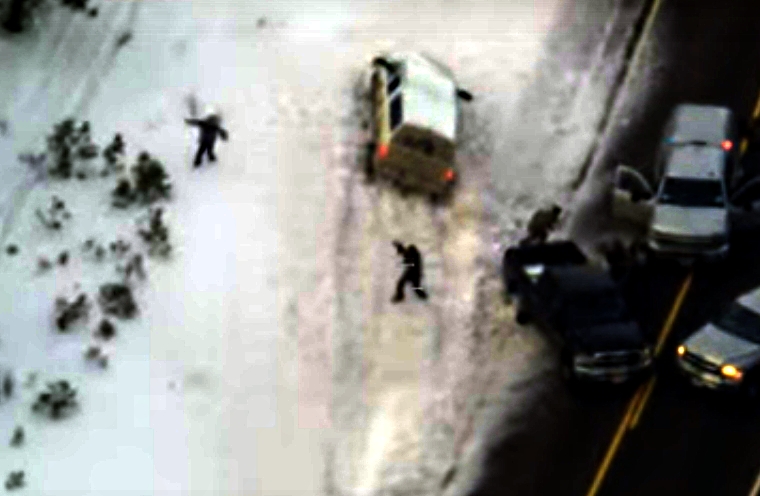
[Update: Subsequent to the publication of this article, the FBI released aerial observation video of the stop in which LaVoy Finicum was killed. Without audio, and from a distance, it is impossible to tell exactly what happened, but what is clear is that Finicum drove away after being stopped, then crashed into a snowbank next to a roadblock a mile or so up the road. Finicum can be seen exiting the vehicle with his hands held high, but as he is confronted by an officer, he appears to reach suddenly into his jacket, upon which he is shot by an officer coming out of the trees. Some are suggesting that Finicum’s “furtive moves” were actually a response to being shot, while others insist that he was clearly reaching for a gun. Finicum was known to carry a pistol in a shoulder rig on that side, and to me, it looks like he is attempting to get at that gun, but I would like to see ground video with audio. All reports are that Finicum was very agitated from the initial stop, and there was apparently concern about passengers in his truck, particularly the 18-year old girl, Victoria Sharp, being placed in danger by any confrontation. It is quite possible that Finicum had determined not to be taken alive, and had exited the truck with his hands up as a way of getting away from the “non-combatants” before engaging the officers. We’ll never know for sure.
Under the law, the actions of the officers involved will be judged by the immediate circumstances, not the larger issues leading to those circumstances. This was an unneccessary death, and I don’t think any of this has helped the cause of liberty or helped to bring justice to the Hammond family. Perhaps it will help to bring attention to the growing stress between citizens, states, and federal land managers. — JAK]
(January 27, 2016) The occupation of a remote wildlife refuge turned violent yesterday when federal agents stopped two vehicles carrying protesters to a town hall meeting in John Day, Oregon. Victoria Sharp, a passenger in one of those vehicles, has reported that federal agents opened fire on the group without provocation after conflicting and confusing demands for the protesters to surrender. Sharp reported that shots were first fired at Ryan Payne as he complied with orders to show his hands out of the window of the vehicle in which she was riding, but that the shots missed. Payne was calling for police to not shoot, as there were women in the vehicle, and exited the vehicle, asking that the women be allowed out.
At this point, LaVoy Finicum, one of the spokesmen for the occupiers, who was driving the vehicle in which Ms. Sharp was riding, yelled out the window that they were going to go talk to the Sheriff (at the meeting in John Day), or that agents could just shoot him. He told the passengers to get down, and drove forward, precipitating heavy gunfire from the agents, and crashing the vehicle into a snowbank.
Ms. Sharp said that Finicum then exited the vehicle, hands in the air, yelling “Just shoot me then!” A volley of shots rang out and Finicum fell to his back, hands still over his head, and was shot several more times on the ground.
Sharp said that agents continued shooting at the car, striking Ryan Bundy in the shoulder as he shielded her on the floorboard, and deploying tear gas before finally taking the rest of the group into custody. According to Sharp, none of the protesters fired a shot or even touched a gun during the encounter.
The full audio of Victoria Sharp’s account is posted on YouTube, and comes across as very credible.
Another report suggested that Finicum “charged” at police after exiting the vehicle, but does not dispute the claim that his hands were in the air. Cliven Bundy, father of Ammon and Ryan Bundy, leaders of the occupation who were both taken into custody during the incident, has further charged that, not only were Finicum’s hands in the air, but he was not armed at the time.
In interviews during the occupation protest, Finicum, a soft-spoken rancher and father of 11 from Arizona, had insisted that he would rather be killed than “put in a cement box” prison. He said that some things were more important than life, and that freedom was one of those things.
The occupation was initiated in protest of the re-incarceration of a pair of Oregon ranchers who had been convicted of terrorism for starting two controlled burns on their graze lands back in 2001 and 2005. The ranchers, father and son Dwight and Steven Hammond, were initially sentenced to, and served short sentences and fined $400,000 for their actions, but a federal appeals court later concluded that the judge in the case had improperly waived a five-year minimum sentence for the charges, and the two were resentenced to that minimum and ordered to return to prison.
I reported on the Hammond case and the resulting protests a few weeks ago in this column, pointing out that the stated objective of the protest was being lost in the news coverage of the protest itself. Ammon Bundy and his compatriots appeared to be more interested in generating a confrontation with federal authorities than in drawing attention to the Hammonds and the abusive practices of federal agencies that led to their plight.
The death of LaVoy Finicum is a needless tragedy.
Federal authorities had wisely been taking a hands-off approach to the occupation, denying Bundy and his friends the opportunity for the tense stand-off they seemed to be seeking. Unfortunately politicians like Oregon’s Democrat Governor Kate Brown, took the occupation as a personal affront, and were calling for law enforcement to take more aggressive action to put a stop to the flagrant defiance of federal authority. The result is a martyr for the fringe and escalation of the situation from a nuisance to a volatile and dangerous level. The strategy was clearly to “remove the head of the snake” by capturing the leaders of the occupation, but what if those leaders were the cooler heads that were keeping the protest calm and peaceful?
With the death of Finicum, in circumstances that some are calling murder, a fuse has been lit, and unless authorities can and do quickly produce evidence that their actions were clearly justified, this could blow up in a very ugly way. And it all could have been easily avoided.
Realistically, what harm were the protesters doing? They were occupying buildings of a remote wildlife refuge in a sparsely populated area of the country in the dead of winter. They were making no threats, harming no one, and getting less and less attention from an unsympathetic media. They were not supported by any national or state militia organizations, and their whole agenda had pretty well fizzled.
I wish Ammon Bundy had taken my advice, negotiated a peaceful end to the situation, and sent his supporters home to their families weeks ago. That didn’t happen, and what happens next is anyone’s guess. The remaining occupiers must be concerned about what might happen to them if they try to leave, especially in light of the death of Finicum, and by setting up roadblocks and checkpoints, authorities have now committed manpower and resources to potentially long, cold, uncomfortable duty that can’t help but engender deeper frustration and resentment between police and occupiers. Any trust that might have developed is completely out the window. Worse, the bloodshed may provoke other groups to step in and escalate the mess even further.
Perhaps yesterday’s arrests will bring this whole thing to a close, but I fear that it is more likely signaling the beginning of something much worse than protesters occupying a wilderness outpost.